

Products Used:
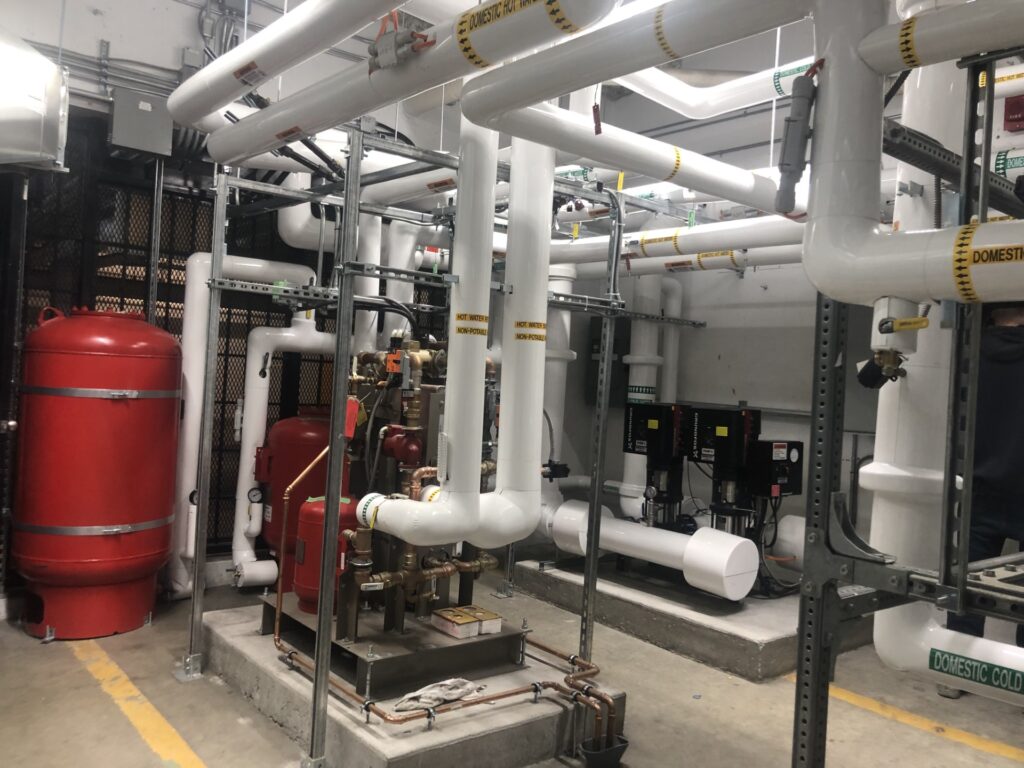
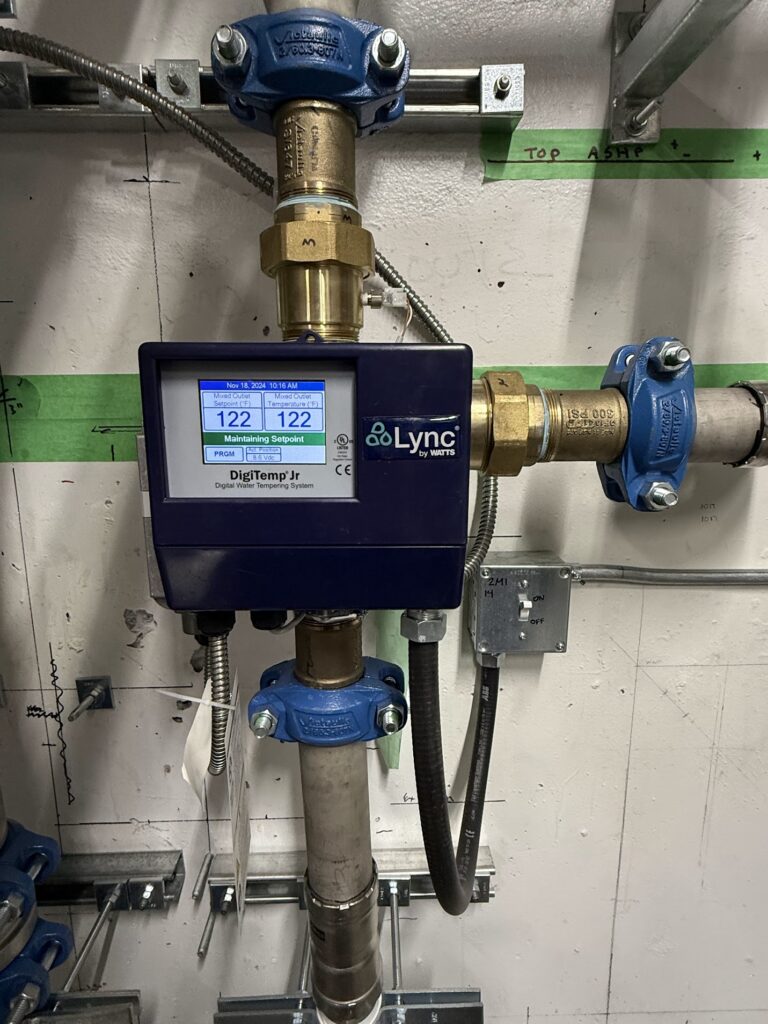
Lync Aegis CO2 heat pump, Lync storage tanks, Hubbell TXA, Grundfos Multi-E
Engineer:
AME Group
Contractor:
Cambridge Plumbing
Location:
Vancouver, BC
Owner:
City of Vancouver
Project Overview
The City of Vancouver recently undertook a major capital maintenance project at the New Continental Apartments, a supportive housing development in downtown Vancouver. As part of a $5M+ domestic water re-piping initiative, the City sought to replace aging systems with a low-carbon, high-efficiency hot water solution that aligned with Vancouver’s Climate Emergency Action Plan and asset renewal goals.
Why the Retrofit?
Buildings are Vancouver’s largest source of carbon pollution, and hot water generation is a major contributor in multi-unit residential buildings. The City has committed to cutting greenhouse gas emissions by over 50% by 2030, and its retrofit program focuses on electrifying heating and hot water systems. The New Continental retrofit was driven by:
-
Capital maintenance needs – the existing domestic hot water piping and equipment required replacement
-
Climate targets – replacing gas-fired or inefficient equipment with zero-emission alternatives
-
Efficiency goals – reducing operating costs while improving reliability for residents
Challenges
The City of Vancouver approached AME Group with the goal of electrifying the domestic hot water system at 1067 Seymour using a CO₂ heat pump. However, the project faced unique site challenges:
-
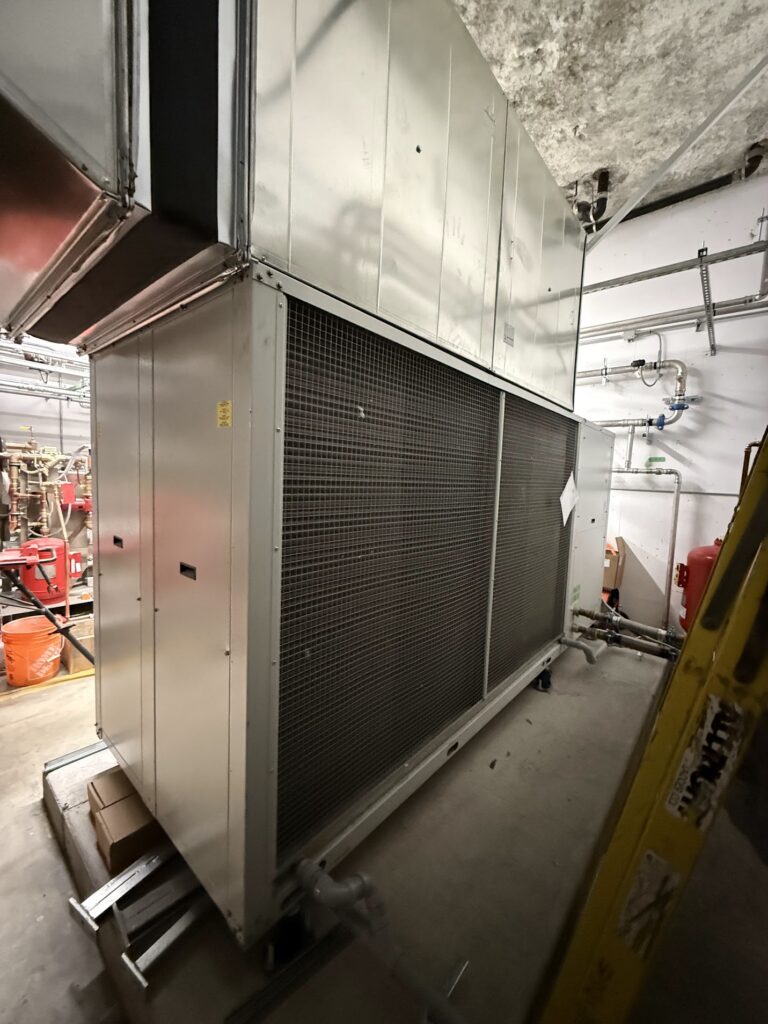
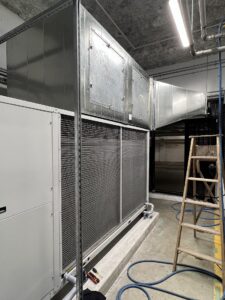
The mechanical space was located in the parkade, where the Aegis heat pump moves approximately 27,000 CFM, reducing the temperature by a few degrees on each pass
-
Without proper ducting designed by AME, the system risked short-circuiting its airflow and overcooling the parkade area
-
Limited space constraints required careful equipment selection and layout
Solutions
To overcome these challenges, AME Group engineered a practical, efficient design:
-
Installed an Aegis A 350 air-source heat pump as a high-COP water heating solution, selected for its compact footprint and strong performance.
-
Utilized CO₂ [R744] refrigerant, a “future-proof” choice with a global warming potential of just one
-
Added a wall-mounted Hubbell backup heater to provide redundancy while conserving space
-
Ducted the exhaust air away from the mechanical room and out through the parkade entrance gate to prevent short-circuiting
-
Integrated an external booster fan to support the heat pump’s fans in moving cooled exhaust air through the ductwork and safely out of the building
Outcomes & Benefits
-
Reduced Emissions: Significant reduction in carbon emissions from hot water generation
-
Improved Efficiency: Lower energy consumption translates to reduced utility costs for long-term building operation
-
Future-Proof Asset: By electrifying domestic hot water, the City has positioned the building to comply with current and future carbon reporting requirements
-
Resident Comfort: Reliable hot water delivery ensures improved comfort and system resilience
The New Continental Apartments retrofit highlights how municipalities can combine capital maintenance projects with climate action goals. By selecting the Lync Aegis CO₂ heat pump system, and overcoming the engineering challenges of a constrained mechanical space, the City of Vancouver reduced greenhouse gas emissions, improved energy efficiency, and future-proofed a critical supportive housing facility—while setting a model for sustainable retrofits across its building portfolio.




<!–



–>